Notes / Speaking Lab
Speaking Lab: talking to an AI IELTS examiner like a voice call
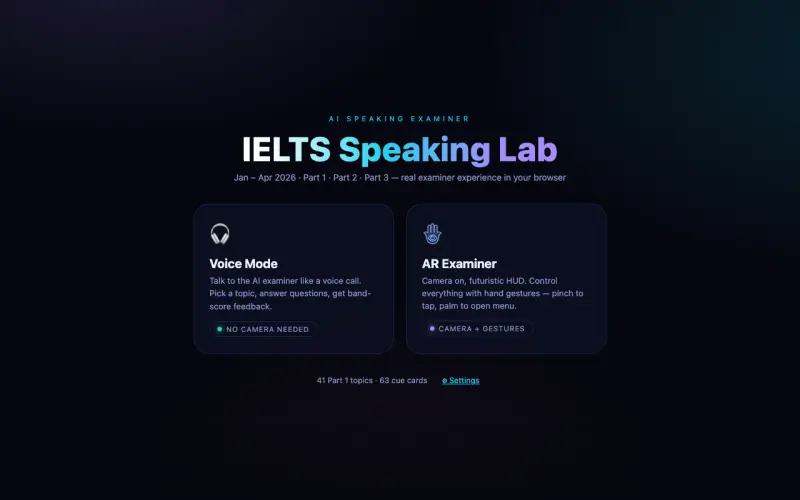
An experiment: an IELTS Speaking examiner you talk to out loud, with the January–April 2026 topics for Parts 1–3, band-score feedback, and a camera mode you control with hand gestures.
- Topics
- Jan–Apr 2026, Parts 1–3
- Examiner
- Gemini
- Voice
- Gemini or the browser's own
- Status
- experiment
- Built
- July 2026
The Speaking Lab is an experiment. Most IELTS speaking practice is reading a question and recording an answer. Here you talk to an examiner, out loud, like a voice call.
You pick a topic from the January–April 2026 question bank for Parts 1, 2 and 3, the examiner asks the questions, you answer, and at the end you get band-score feedback. You can also add your own topic: a cue card and a list of questions, one per line, saved on your device.
How it talks
The examiner runs on Google's Gemini. The page asks for one of two things:
- A Worker URL, recommended. A teacher puts the API key behind a small server function, so students never see it.
- Your own Gemini API key as a fallback, which you can get for free from Google AI Studio.
The examiner's voice can be Gemini's natural voice or the browser's built-in one, which is free. With auto-listen switched on, the page starts listening as soon as the examiner stops talking, so the conversation flows without buttons.
The gesture mode
There is a second mode that is pure experiment: the camera turns on, a futuristic heads-up display appears, and you control everything with your hands. A pinch is a tap and an open palm opens the menu. It is not how most students will practise, but it was a way to test how far a browser page can go without a single tap.
How it fits with FlareStamina
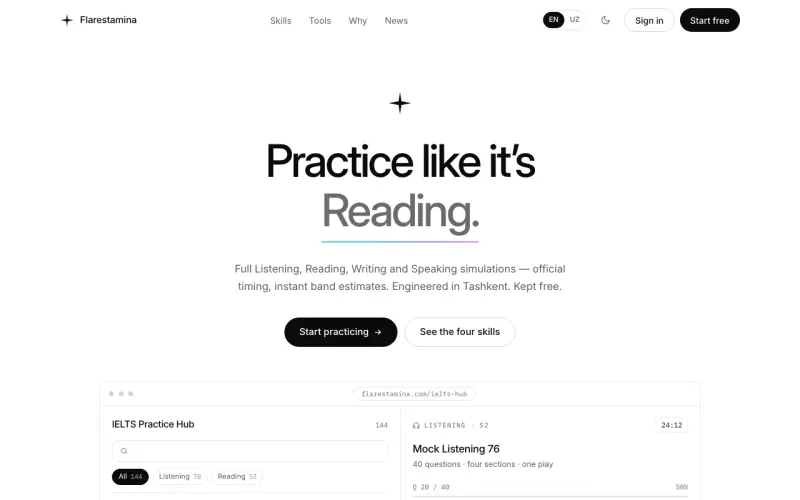
This is not the same as the Speaking section of FlareStamina. That one is for classes: students record answers to 166 official topics and a teacher listens and leaves a band and notes. The Speaking Lab is for practising alone, with a machine on the other side, when no teacher is available.
Try it at ielts-speaking-lab.pages.dev. It works best with headphones and a quiet room.